Protection Response Tactics®
Defensive Tactics For Protection Professionals
Prepare professionals to protect people, manage force, and make defensible decisions under pressure. Choose instructor certification or bring Protection Response Tactics to your team.
Why PRT Exists
Protection Is A Different Mission
A protector is not trying to win a contest or remain in a prolonged fight. The responsibility is to reduce client risk, manage the environment, create movement, and use the lowest reasonable level of force that resolves the problem.
Use awareness, positioning, communication, and environmental control to prevent unnecessary physical engagement.
Protect the client, create movement, control the immediate problem, and keep evacuation available.
Recover awareness, account for the client and team, and explain the response with professional clarity.
Two Ways To Train
Choose Your Path In Protection Response Tactics
Choose the training path that fits your mission.
Professional Outcomes
What PRT Develops
PRT prepares protection professionals to make better decisions, use defensible responses, and operate effectively in the environments where protection work actually happens.
Better Decisions Under Pressure
Read changing conditions, select an appropriate response, and preserve the protection mission when time and options narrow.
Proportional And Defensible Responses
Use communication, movement, control, and force in ways that are appropriate to the threat, environment, client, and mission.
Training Built For Protection Environments
Prepare for vehicles, confined spaces, bystanders, equipment, team movement, and the realities of protecting another person.
See inside the Academy
Your Development. Organized and Connected.
Your development continues between camps. The PRT Online Instructor Academy brings your courses, learning tools, and instructor community into one place.
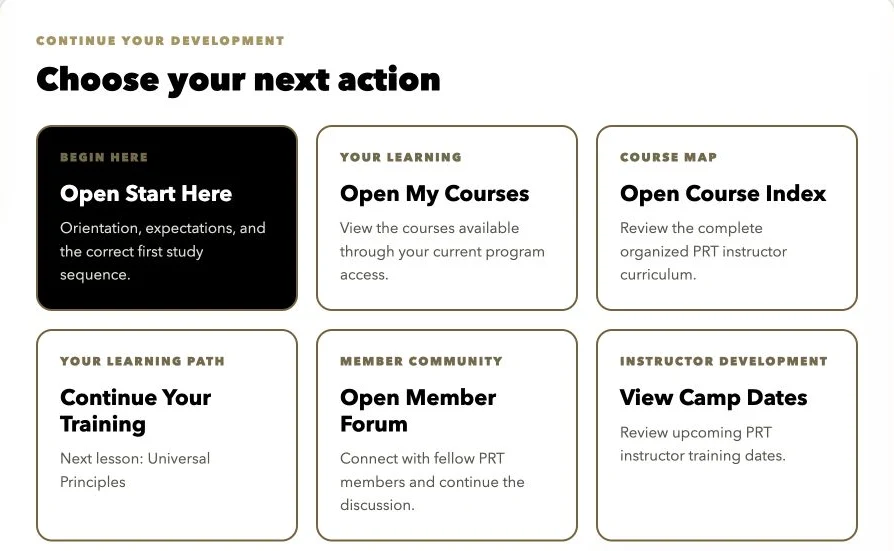
Know your next step.
Begin with your orientation, find your courses, and follow the curriculum through an organized learning environment.
Keep your development moving.
Return to lessons, follow your course progress, and keep your instructor biography and profile current when listing access is available.
Stay connected.
Ask questions inside your lessons, participate in the member forum, and receive Academy updates as you continue your study.
How your learning tools and communication work
Courses and progress. Your dashboard connects you to Start Here, your available courses, the course index, and your next lesson. Course progress helps you see where to continue.
Your instructor presence. Eligible instructors can update their public biography, photo, websites, social links, and location display through the bio editor. The PRT team manages certification and account access.
Questions and support. Use lesson comments for questions about the material you are studying. Use the forum for broader discussion, and contact Jennifer for individual program or account assistance. Thoughtful questions are welcome.
Academy updates. Check your dashboard for PRT and The Capable Academy announcements. You can also choose email notifications for PRT Academy Updates.
Course and listing access depend on your program status. Online study supports instructor development. Certification and teaching authority require successful completion of the PRT certification process.

Meet The Founder
Experience Shaped Around The Protector’s Mission
Alan Baker developed PRT through decades of studying, teaching, and building training systems across martial arts, defensive tactics, executive protection, and personal security.
The program grew from a practical question: what does a protection professional need when avoidance and evacuation are no longer enough?
Professional Perspectives
Why The Work Matters
Listen to experienced professionals describe the relevance of protection specific training, instructor development, and accountable decision making.
Jerry Heying
Executive Director, Executive Protection Institute
Antonio Alfonso
Sergeant Retired, New York Police Department
Nathan McKnight
Founder, ClearWater Protection
Build The Right Capability
Choose The Next Step That Fits Your Mission
Develop yourself through the instructor pathway, or bring PRT to the team responsible for protecting your people and organization.
The PRT Field Briefing
Stay Connected To The Work
Receive professional training insights, program updates, and practical considerations for protection focused development.
Questions
Start With Clarity
If your organization has a specific training need, the PRT team can help you determine the right next step.
What Is PRT?
Protection Response Tactics is a defensive tactics system built around the responsibilities of professionals who protect other people.
Who Is PRT Designed For?
PRT serves executive protection professionals, private and corporate security teams, instructors, training directors, and organizations responsible for personal safety.
Do I Need Protection Experience To Begin?
The instructor pathway supports committed professionals at different stages of development. The PRT team can help determine the most appropriate starting point.
Should I Choose Certification Or Team Training?
Choose certification when you want individual instructor development. Choose team training when your priority is building shared capability inside an agency, company, or security organization.