Protection Response Tactics® Orientation
This Is Not Recycled Defensive Tactics
A professional introduction to the mindset, design standards, and instructor development process behind Protection Response Tactics®.
Protection Response Tactics® was not created by repackaging martial arts, law enforcement defensive tactics, or military combatives for the protection industry.
It was built from the ground up for the realities of protection work, where client safety, professional judgment, optics, legal explainability, environmental pressure, and mission success all matter.
If you are here, you have been invited to look deeper into the thinking behind the system.
The Purpose Of PRT
Built For The Realities Of Protection Work
Protection Response Tactics® was designed to fulfill the unique requirements of the Personal Protection Specialist. The goal is not simply to teach someone how to fight. The goal is to give the protection professional appropriate responses that reduce risk to the client, the agent, the team, and the mission.
A protection agent operates under a different standard. Avoidance may be the best answer. Evacuation may be the best answer. Verbal direction, posturing, placement, soft control, or physical intervention may be required. Sometimes higher levels of force are necessary, but the response must still fit the environment, the level of risk, and the professional responsibility of the role.
Client Risk Comes First
The protector’s goal is to reduce risk to the client, not to win a personal confrontation or prove physical dominance.
The Environment Changes The Tactic
Vehicles, crowds, cameras, doorways, teams, bystanders, and public perception all change what is appropriate.
The Response Must Match The Problem
PRT gives the practitioner tools across multiple levels of force so the answer fits the situation, the risk, and the mission.
The Industry Problem
The Problem With Recycled Training
Much of what is presented to the protection industry as defensive tactics is not truly built for protection work.
In many cases, it is martial arts, law enforcement defensive tactics, military combatives, or sport-based material that has been repackaged and pointed at a new audience. Some of that material may have value in its original environment, but that does not mean it fits the responsibilities of a protection agent.
A protection professional operates under a different standard. The problem is not simply whether a technique can work in a fight. The real question is whether the response fits the client, the mission, the environment, the optics, the level of force, and the legal reality of the situation.
Protection Response Tactics® was designed to fulfill the unique requirements of the Personal Protection Specialist by giving the practitioner appropriate responses across levels of risk. The goal is to reduce risk to the client through the right response, not simply to win a physical exchange.
Wrong Environment
A tactic built for a ring, mat room, patrol context, or battlefield may not fit a public, client-centered protection environment.
Wrong Level Of Force
Many systems move too quickly into assault-level answers, even when the situation requires control, restraint, positioning, or de-escalation.
Wrong Professional Standard
The protection agent must consider cameras, witnesses, public perception, legal explanation, team movement, and client safety.
The Design Laws
Visually Appropriate. Socially Acceptable. Legally Explicable.
Protection Response Tactics® is not judged only by whether a tactic can work physically. Every response must also fit the professional realities of protection work.
A protection agent may be working around a client, a team, a crowd, a camera, a public venue, a doorway, a vehicle, or a legal review after the event. That means the tactic must be effective, but it must also be appropriate to the environment, acceptable within the social context, and explainable after the fact.
Visually Appropriate
The response must make sense when seen by a client, camera, witness, team member, employer, or public audience.
Socially Acceptable
The tactic must fit the social environment and avoid unnecessary escalation when lower-level control is available.
Legally Explicable
The practitioner must be able to explain why the action was reasonable, necessary, and appropriate within the circumstances.
Environmentally Designed
The tactic must work around vehicles, crowds, walls, doorways, confined spaces, bystanders, and the realities of protection work.
PRT does not simply ask, “Can this work?” It asks, “Can this work here, in this role, with this client, under this level of scrutiny?”
The Force Continuum
Effective Answers Across Multiple Levels Of Force
Protection Response Tactics® is not a random collection of techniques. It is built around a force continuum so the protection professional can match the response to the threat, the environment, the client’s safety, and the professional standard of the moment.
The goal is not to escalate. The goal is to respond appropriately. In protection work, the best answer may be verbal direction, posturing, soft control, hidden force, assault-level tactics, or lethal force. PRT gives the practitioner a structured way to understand where they are in that progression and what level of response the situation requires.
Protection Professionals Live In The Lower Levels
Most protection agents are not making a fist every day. They are managing distance, influencing behavior, controlling access, guiding movement, creating space, and placing hands on people at lower levels of force.
But They Must Be Ready For Higher Levels
When avoidance, evacuation, de-escalation, or soft control are no longer enough, the practitioner must be prepared to act decisively while still protecting the client, the mission, and the professional standard.
The professional question is not, “How much force can I use?” The professional question is, “What level of response is appropriate right now?”
The Lower Levels
Most Protection Work Happens Before The Fight
Protection professionals rarely live in the dramatic end of the force continuum. Most of the work happens earlier, before the situation becomes a fight.
This is one of the major differences in Protection Response Tactics®. PRT gives serious attention to verbal skills, posture, critical distance, control by placement, soft-control contact, escort positions, de-escalation, and disengagement because these are the tools protection professionals use most often.
Lower-Level Skill Prevents Higher-Level Problems
A protection agent may need to influence movement, create space, interrupt behavior, guide a person away from a client, condition witnesses, or control access without creating unnecessary escalation. This requires more than fighting skill. It requires awareness, timing, communication, placement, restraint, and judgment.
Critical Distance
Understanding range, body position, intent, and the path of the threat before physical contact becomes unavoidable.
Verbal Tactics
Using communication to de-escalate, influence witnesses, control the exchange, and force the threat to reveal intent.
Soft Control
Using socially acceptable physical contact to guide, redirect, escort, and control without unnecessary escalation.
Disengagement
Knowing when to reduce pressure, create space, move the client, exit the situation, or transition to the next appropriate response.
Instructor Development
More Than A Certification
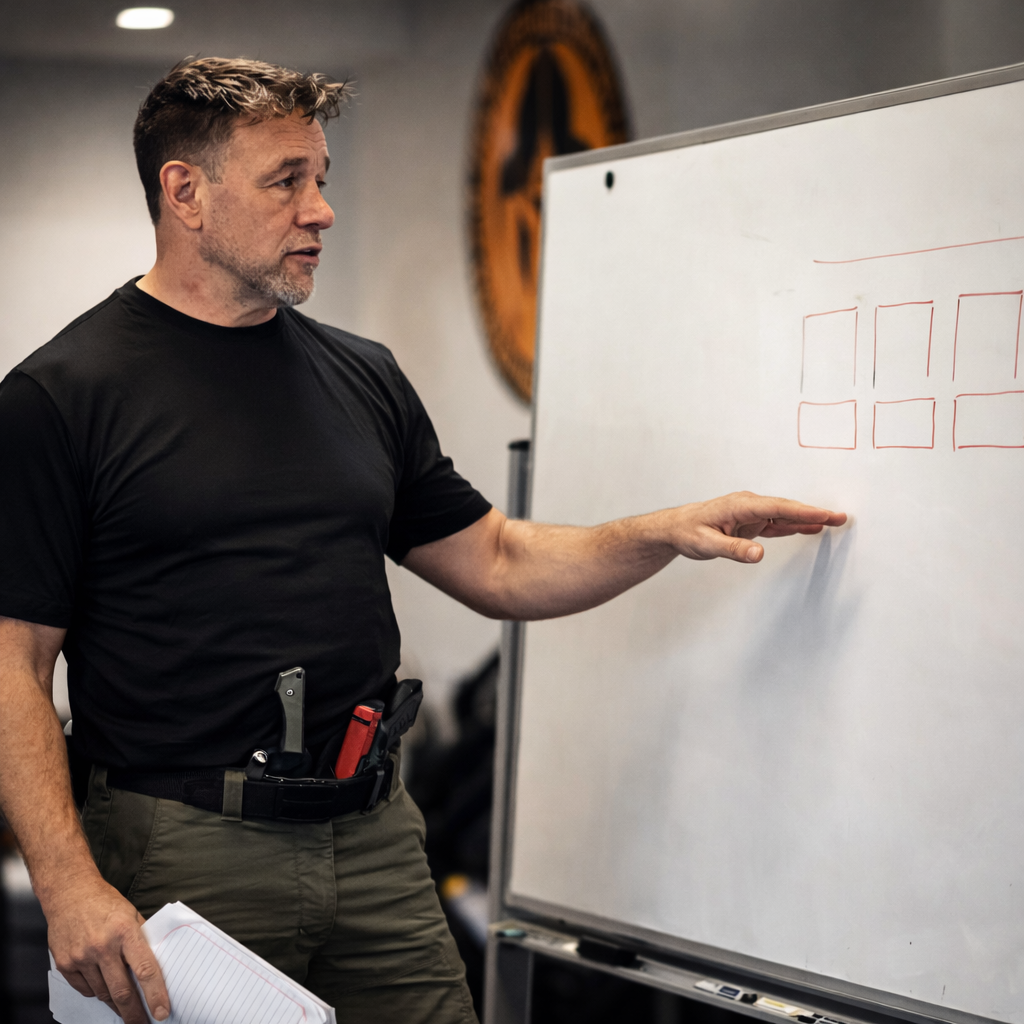
Protection Response Tactics® is not designed to produce certificate holders. It is designed to develop better educators.
A PRT instructor must understand more than the movement. They must understand the mission, the professional context, the force continuum, the design standards, and the teaching methodology behind the system.
The goal is not to hand someone a certificate and send them back into the field with a shallow understanding of defensive tactics. The goal is to cultivate principled instructors who can raise the standard of training inside the protection industry.
Perspective Shift
Great instructors do not simply repeat techniques. They understand why the methods exist and how to adapt principles to different students, environments, and levels of force.
Hands-On Proximity
Timing, pressure, mechanics, energy, and control cannot be fully understood through video alone. They must be felt in the room through direct contact and live training.
Ongoing Consistency
Instructor development continues through live events, refinement, community, and regular alignment with the standards of the association.
PRT is not a shortcut to a credential. It is a path toward becoming a more capable, principled, and professional defensive tactics educator.
The Online Platform
A Living Instructor Development Resource
The Protection Response Tactics® Online Instructor Platform is not a static collection of videos. It is a growing instructor development resource designed to support the curriculum, preserve training material, and keep instructors connected to the evolution of the system.
PRT instructor development does not end when the live event is over. Live training is essential because timing, pressure, energy, mechanics, and control must be felt directly, but the online platform keeps the learning process alive between events.
The platform gives instructors a structured place to review curriculum, study instructor-level material, revisit camp recordings, access support resources, and stay aligned with the standards of the association.
Curriculum video archive
Instructor-level training material
Instructor camp recordings
Public event footage when appropriate
Instructor manuals and support materials
Marketing resources, logos, and student cards
Built To Support The Instructor Over Time
The platform is built, maintained, and continually developed by Bob Burgee, who serves as Technical Director for the PRT online instructor platform. The purpose is to give instructors more than access to a course. The purpose is to support a growing professional development system.
You are not just attending a course. You are entering a growing instructor development environment.
In this walkthrough, Jennifer introduces the instructor portal and shows how candidates can navigate courses, review materials, track progress, and access ongoing support resources.
Inside The Instructor Portal
A Closer Look At The Online Platform
Once an instructor candidate registers for certification training, they receive access to the PRT Instructor Portal. This allows them to begin reviewing material before the in-person event and continue studying long after the live training is complete.
The portal is organized by course level, so candidates can see the materials connected to their current instructor path. Level 1 includes the materials connected to Phases 1 and 2, along with general resources, instructor development material, written content, and additional support tools.
Course-level video materials and curriculum review
Progress tracking to see what has been completed
Instructor camp recordings and additional training resources
Written content, teaching methodology, and coaching tools
Comments, questions, and responses from Alan or the PRT team
Manuals, logos, marketing materials, brand keys, and support documents
The portal helps the instructor candidate prepare before training, review after training, and stay connected to the continuing development of the system.
Who PRT Serves
Built For Those Responsible For Others
Protection Response Tactics® is for professionals and instructors who understand that protection work requires more than fighting ability.
The system was built for people who need practical answers that fit the protection environment: client safety, professional judgment, lower-level control, public optics, legal explainability, environmental pressure, and appropriate response across multiple levels of force.
PRT is especially valuable for those who are responsible for protecting clients, students, personnel, teams, families, organizations, or others who depend on their judgment under pressure.
- You are responsible for protecting clients, students, personnel, or others.
- You need lower-level control tools that fit professional environments.
- You teach defensive tactics and want a deeper instructor development path.
- You understand that optics, legality, restraint, and judgment matter.
- You want training built for protection work, not recycled from another field.
Executive Protection Professionals
Personal Protection Specialists
Private Security Professionals
Agency Owners And Team Leaders
Martial Arts And Defensive Tactics Instructors
Firearms Instructors And Serious Practitioners
If your work requires you to protect others, your training must be judged by a higher standard than whether it can simply win a fight.
Teaching Philosophy
Guided By The Combat Blueprint
Protection Response Tactics® is guided by a broader combat study framework that helps identify the environments where protection-based defensive tactics must function.
Many systems become trapped inside one art, one range, one training method, or one category of tactics. Protection work does not allow that. A protection professional may face distance-based threats, weapons, striking, close-range control problems, or ground engagements, often while also managing a client, a team, a vehicle, a crowd, or a public environment.
The Primal Environments
Primal Environment
Projectiles
Projectiles represent distance-based threats and tools. In protection work, this environment forces the practitioner to consider line of sight, movement, barriers, access, timing, escape routes, and the reality that not every threat begins within arm’s reach.
When this environment is ignored, the protection professional may be prepared for contact but unprepared for distance.
A protection professional cannot afford to train for one environment and be surprised by the others.
The Next Step
Continue Your PRT Education
If this orientation has helped you see defensive tactics differently, the next step is to continue the path through instructor training, team training, or a direct conversation with the PRT operations team.
Protection Response Tactics® was built for people who take the responsibility of protecting others seriously. If this is the standard you are looking for, choose the path that fits your current role and objective.
Get Certified
Begin the instructor certification pathway and learn how to become part of the PRT instructor development process.
Instructor Program 02Train Your Team
Explore in-person training options for agencies, organizations, security teams, and professional groups.
Team Training 03Start The Process
Contact the PRT team with questions about certification, team training, upcoming events, or the right path forward.
Contact Us
When You Start The Process, Jennifer Will Help Guide The Next Step
Jennifer serves as the Operations Director for the program. If you reach out through the contact page, she will help you with questions, scheduling, program details, and the next step that fits your training goals.
Start The Process