Protection Response Tactics® Field Notes
Simplicity Under Pressure: Why Protection Professionals Need Principles, Not More Techniques
When the client, environment, team, threat, and consequences are all moving at once, complexity becomes a liability.
I recently completed a three-and-a-half-week teaching tour that ended in Double Springs, Alabama, at a collaborative training event called Combatives at the Lake.
Chris Magyar hosted the three-day event at a property on the lake. I taught primarily on Saturday, but the schedule also gave me time to observe, speak with other instructors, and learn from the different perspectives represented in the room.
This was not a Protection Response Tactics® certification course. It was a collaborative combatives environment, and that distinction is important. When I step outside my own curriculum, I am not looking for more material simply to collect it. I am looking for principles that remain true across systems, personalities, and operating environments.
One principle kept returning throughout the weekend: simplicity is mastery.
The Operational Problem
Protection Does Not Reward Complexity
A protection professional is rarely solving only one problem. The threat may be in front of you, but the client may be beside or behind you. A teammate may be moving. A vehicle door may be open. Bystanders may be compressing the available space. Cameras may be recording. The path to safety may be disappearing.
At the same time, the protector must evaluate the level of force, the legal and social consequences of the response, the position of available weapons, and whether physical engagement is helping or delaying the protective mission.
That is a significant decision load. A tactic that requires perfect timing, several dependent steps, ideal positioning, or exclusive attention to the aggressor may be technically impressive and still be operationally wrong.
The protector does not need the most complicated answer. The protector needs the clearest appropriate answer that reduces client risk and preserves the mission.
The best response is not the most impressive one. It is the clearest appropriate one.
The PRT Educational Standard
Principles Before Techniques
Protection Response Tactics® is not built around memorizing a large inventory of disconnected movements. Techniques matter, but a technique is an application. It is an answer expressed under a particular set of conditions.
Conditions change. Timing changes. Position changes. Space disappears. The client moves. The aggressor changes levels. A weapon becomes visible. Another person enters the problem. A memorized sequence may stop fitting before the second step is complete.
Principles give the protector something more durable. Protect the client. Preserve movement. Manage the threat without losing the environment. Match the response to the problem. Maintain access to an exit. Use force that can be explained afterward. Return to the protective mission as quickly as possible.
Simplicity does not mean lowering the standard or removing advanced capability. It means organizing deep knowledge so that the practitioner can recognize what matters, select an appropriate response, and act without unnecessary delay.
The simple answer is often the product of more study—not less. It takes experience to remove what is decorative, fragile, or dependent on ideal conditions while preserving what is functionally essential.
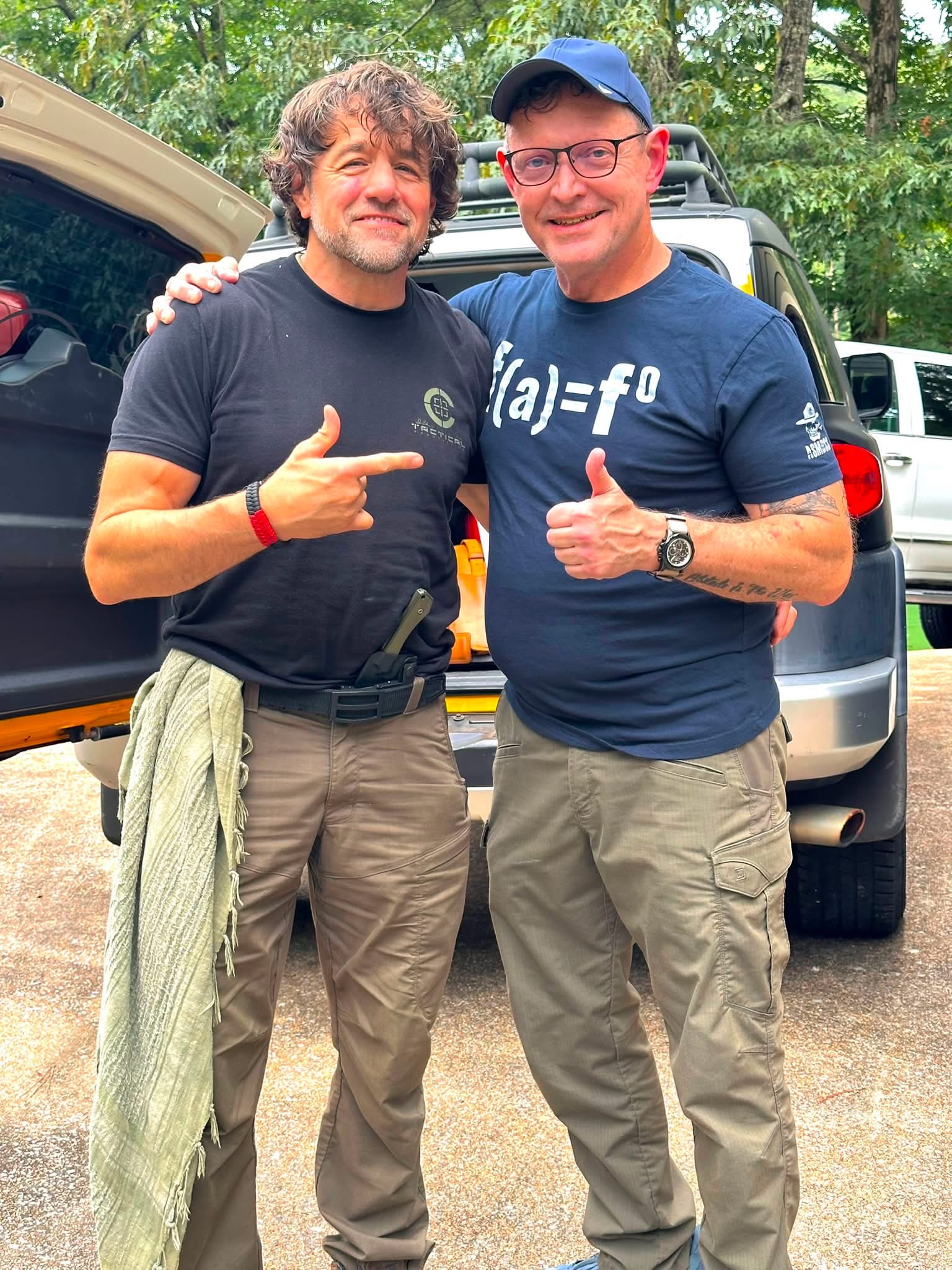
Alan Baker with Coach Chris Mize during the collaborative training weekend in Double Springs, Alabama.
Instructor Development
Professional Instructors Must Remain Students
One of the dangers of experience is that it can make an instructor too comfortable being the person with the answer. That is exactly when blind spots become harder to see.
I have always believed that we do not know what we do not know. When I am around capable educators, I make it a point to become a student again. I listen to how they frame problems. I watch which details they emphasize. I pay attention when different instructors arrive at the same principle from different directions.
That is not an abandonment of standards. It is how standards improve. New information still has to be filtered through the protection mission. Does it reduce risk to the client? Does it preserve movement? Is it appropriate for the environment and force level? Can it be taught, pressure-tested, and explained?
The protection instructor’s responsibility is not to bring every new technique home. It is to identify what improves professional judgment and then integrate it without weakening the system.
A Simpler Decision Model
Recognize. Select. Protect.
Simplicity becomes useful when it improves the practitioner’s ability to make an appropriate decision while the environment is changing.
01
Recognize
Read the developing problem early. Track the client, threat, team, terrain, available exits, bystanders, and indicators that the force level may be changing.
02
Select
Choose the lowest response that can solve the actual problem without sacrificing safety, mobility, control, or the ability to escalate when necessary.
03
Protect
Keep the client and mission at the center. Use the response to create movement, restore a safer position, and exit the confrontation as soon as conditions allow.
Protection Response Review
Test the Answer Before You Trust It
When evaluating a tactic, drill, or piece of curriculum for protection work, move beyond the question, “Can this work?” Ask:
- Where is the client while this response is happening?
- Does the tactic preserve movement or trap the protector in the confrontation?
- Does the response match the actual level of force?
- What changes around vehicles, walls, doorways, crowds, cameras, or confined spaces?
- Can the protector maintain awareness of teammates, bystanders, exits, and weapons?
- Can the decision be clearly explained as reasonable, necessary, and appropriate?
The Professional Standard
A Simpler System Is Harder to Build
Anyone can add another technique. The harder work is deciding what deserves to remain, what can be removed, and which principles allow the practitioner to adapt when the planned answer no longer fits.
That is part of the responsibility of a professional instructor. We study broadly, test honestly, simplify carefully, and teach in a way that leaves the protector more capable of making a sound decision—not merely more capable of repeating a sequence.
When the environment becomes complicated, has your training made the decision clearer?
Continue the Education
Begin the PRT Orientation Journey
Study the mindset, design standards, force continuum, and instructor-development philosophy behind a system built specifically for professionals responsible for protecting others.